


Group Policy Preferences Not Applying? Most of the time, our issues will come down to a handful of items and misconfigurations. As awesome as they may be, Group Policy Preferences (GPPs) gave us a whole new set of challenges and a few new ways to troubleshoot. Let’s go through the top ways to troubleshoot preferences (and learn a few performance tricks on the way)!
Category Archives: TroubleShooting
This category contains any posts with TroubleShooting tips
Updating Software with Group Policy
Updating software with Group Policy is the most difficult aspect of GPSI. To make things complicated, the software you are upgrading may not have been deployed with Group Policy to begin with! So what is an administrator to do? How can we avoid blowing our legs off when we upgrade? Follow these steps and find out!
CSE Processing Order – Know LSDOU? Learn this too!
One of the first things you are taught with Group Policy is LSDOU. Knowing that, you might think that all GPOs linked at a site are processed, then the domain, and then any OU/sub-OU. Any settings left would be the resultant set of policy, right? Not quite! If you have a complicated GPO with different items set (applications, preferences, security, etc), you need to know a second list. Enter the order of operations, also known as the CSE Processing Order.
Continue reading
Group Policy Verbose Mode: The One Group Policy Setting That You Need to Enable
Group Policy is an extremely flexible and complicated tool. One question I am asked quite a bit is, “Can you give me a list of settings I need to enable?” The short answer is No, Microsoft has already enabled the vast majority of things that should be enabled. And while Microsoft’s guidance may change over time (see Offline Files as an example of this), most settings stay the same. There is one setting, however, that is not enabled by default. If you are going to use Group Policy and want to make your troubleshooting life easier, you will want to enable it.
Multiple Remote Desktop Sessions = A Happy Helpdesk
An update to this post (that covers Windows 10) is now available here.
You are checking the helpdesk and a new problem rolls in. You know the solution but you (the administrator) will need to login. You immediately remote into the machine only to see that the user is showing a presentation or actively using it.
Do you:
A) Call the user and have them log off so that you can start fixing the problem. The problem will get fixed but the user is interrupted for 20 minutes.
B) Wait until later in the day and hope the user isn’t using their computer. The problem will get fixed at the end of the day but the user had to deal with it all day.
C) Use RDP and log into the computer. The user is able to continue the presentation. You are able to fix the problem in the background. Everybody is happy!
The answer is C!
“That’s wrong!”, you say! “Client OSs can’t have concurrent RDP sessions. When you try, you get an ugly message and the current logged in user is logged out!”
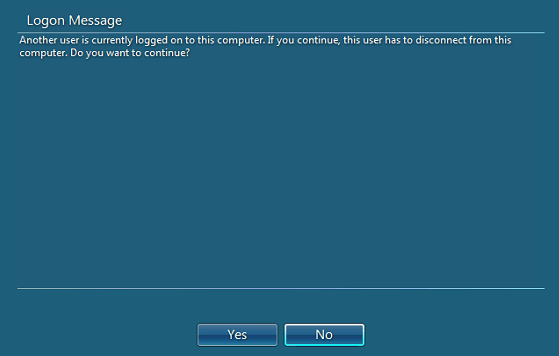
If Server can, the client can! All we have to do is trick it! How? Let’s find out! Continue reading